
Why Everyone Should Watch Star Trek: Enterprise
- nataliemartina
- Aug 16, 2025
- 6 min read
SPOILERS for Star Trek: Enterprise
Star Trek: Enterprise began airing in 2001, and for many fans, would be the final show deemed "classic" Star Trek. The show is chronologically the first in the Star Trek world and details the first voyage of the NX class starship, Enterprise, under the lead of Captain Jonathan Archer, who is, in most ways, the most moral man I have ever seen.
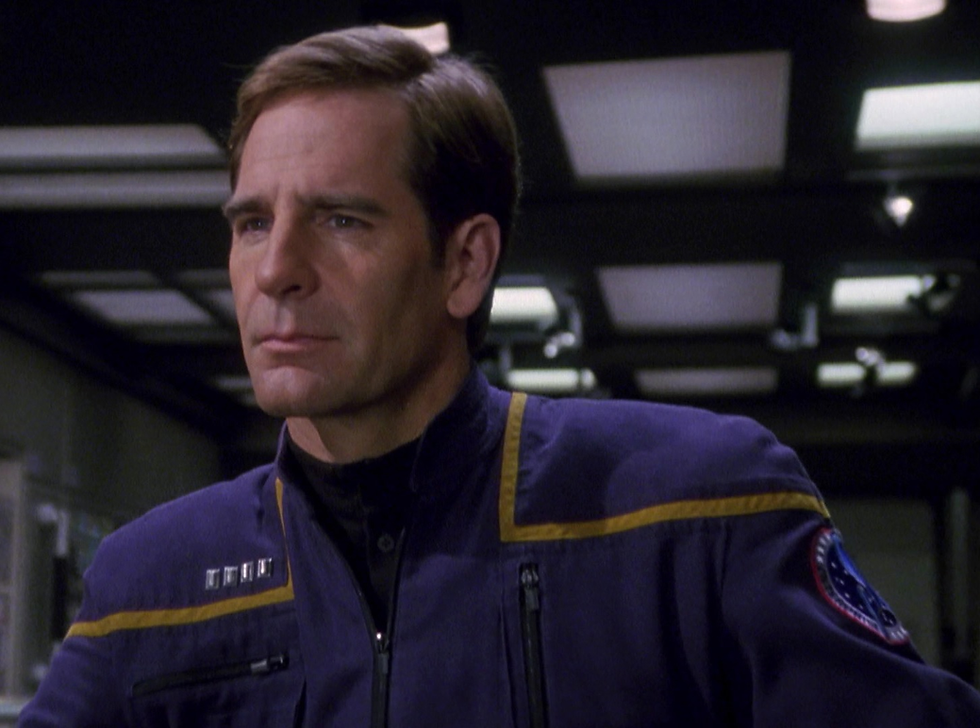
Like many of the Star Trek shows, Enterprise explores many moral dilemmas, many of which still plague our world today. It is why I believe everyone, at some point during their lifetime, should watch this show. Here are some of the largest moral dilemmas in Enterprise.
P'Jem
In the episode titled "The Andorian Incident," which occurs relatively early into season 1 of the show, Archer and his first officer, T'Pol visit a Vulcan temple called P'Jem. While there, the temple is ambushed by a group of Andorians, a species known for their blue skin.

The Andorians claim that the Vulcans have been spying on them and hold all those at P'Jem at gunpoint, demanding answers. The Andorians seem crazy, both to the characters in the episode, and to the viewer...until they don't. Archer discovers that the Vulcans have been using P'Jem as a decoy base for their operations. And he doesn't stand for it.
Instead of following protocol, he asked T'Pol, who is a Vulcan and certainly takes issue with P'Jem's being scrutinized, if she'll have any issue with him exposing what the Vulcans have done. His tone is firm-- he is not asking, he is telling her: this is not okay, and I'm going to set this right, no matter the consequences.
Archer gets into a lot of trouble for this little ploy. The Vulcans are furious at the bombing of their sacred monastery. But Archer is firm in his reasoning. The Vulcans got themseleves into this mess, not him. By spying on the Andorians, they gave the Andorians reason to attack and not trust them. It is up to them to make it right. It is one of many times Archer decides to hold morality over the rules of Starfleet, and while he almost causes a war between two other species, he does gain a solid ally, Commander Shran.
Pa'nar Syndrome: a metaphor for rape violence
CW: rape, HIV

In the rightfully-named episode, "Stigma," it is revealed that T'Pol has a neurological condition that is fatal to Vulcans: pa'nar syndrome. The illness progresses much as HIV does, and can only be contracted through a mind meld that is done improperly.
Mind melds can only be performed by Vulcans. In the episode "Fusion," a Vulcan who has never suppressed his emotions, which is core to Vulcan tradition and belief, mind melds with T'Pol against her will. Additionally, because he has not suppressed his anger, he rages at her. The combination of these two things leads to T'Pol developing pa'nar. The similarities between what happens to T'Pol and what happens to rape victims is eerily similar, and the devastation of pa'nar paints an important lesson about rape victims.
Pa'nar, because of how it is contracted, is highly stigmatized. When Vulcan high command learns that T'Pol has it, they ostracize her, telling her she must leave her post on Enterprise. They also refuse to share the treatment with her because it is not socially acceptable to participate in mind melds as T'Pol has. But she did not ask for the meld, and the consequences are not hers to hold.
Once again, Archer steps in. He is T'Pol's ally, telling the council how absurd it is that they will not treat one of their own just because the illness is stigmatized. He goes one step further and tells them that the mind meld was performed on T'Pol without her consent. When the council hears this, they trip over themselves to apologize and help her.
And then Archer asks the winning question: why is it that they only helped her when it was done to her? Would they not have helped one of their own on their own volition without this knowledge?
They are shamed. Deeply shamed.
This aligns similarly to the stigma of HIV/AIDS. Why should we not help people, even if they did participate in sex? Even if they might have made a mistake? And what if they were raped? Should we not help them then?
These powerful episodes put together serve as a moral lesson for those who look down on others for their mistakes or for their illnesses. It is not right, and Archer makes that very clear. Sometimes, sci-fi and fantasy helps us see our world a little clearer.
The Xindi
Season two ends with a horrific incident: a line being cut into Earth by a weapon built by a species called the Xindi, killing 7 million people. Enterprise's mission of exploration comes to a sudden halt as its new mission becomes clear-- find the Xindi and destroy their weapon before they destroy the rest of Earth.

This easily could have been an us-vs-them conflict, but like all conflicts in Enterprise, Archer must shine through. The chief engineer of Enterprise, Commander Charles "Trip" Tucker, has stake in the game as well. His sister, Elizabeth, was killed by the Xindi attack, and while he wants to find the Xindi and end them, he listens to Archer's firm command that their mission is peace and understanding, rather than more violence.
The preservation of life at all costs, even life that may be a potential threat, is core to Archer's identity. Archer knows that Trip is hurting, and does not tell Trip to push this away, but rather explains that there must be more to a picture. Not all humans are bad, but some are. Archer urges his crew that this is not a mission of violence, but rather reconnaissance-- helping the Xindi understand that they are not a threat and do not mean to end them.
Degra, one of the Xindi, is also core in the understanding of the complexities of the conflict. He is the Xindi who is in charge of making the weapon that will destroy Earth. Because of a message given to them by another species that act as almost gods to the Xindi, they believe they are threatened by humans. Therefore, the Xindi believe that they must end humans before humans end them. Degra, when he meets Archer, is the first to advocate for peace. He, more than any of the Xindi, feels horrible for what he has done in the creation of the weapon, and seeks to understand the commonalities between himself and his species, and the humans. Degra dies for these actions, but he begins the start of a powerful connection.
There are many complexities to season 3 that I think many people ignore, as season 4 is so popular among fans. But season 3 provides the pinnacle of moral dilemmas that makes it worth the watch for anyone.
Clones
Yes, even Star Trek has a clone episode. But its tragedy is similar to the plot of Never Let Me Go by Kazuo Ishiguro (please see my review of this book on this blog). When chief engineer Trip Tucker takes a nasty beating after being electrocuted, becoming essentially brain dead, the only solution is a partial brain transplant. Now, because everyone has unique brains, there is no way to save Trip unless there was another him, and so the doctor of the ship, Phlox, proposes an idea that is ethically problematic: make a clone of Trip uses a specific species that lasts only a few days and grows astronomically fast. This clone becomes Similitude, or Sim.
Phlox would not have suggested this idea if it hadn't been for the fact that humans were at war with the Xindi, and Trip was crucial to that mission. So difficult choices must be made.
As Sim grows, Archer tells him the truth of his existence, explaining Sim must die to save Trip. It's heartbreaking, as Sim holds the same memories and has autonomy.

This is the episode that made me cry, because it was so like Never Let Me Go, and everyone who watches this episode knows where it will go. This poor child grows up knowing his sole mission is to die for someone else-- for himself, really. What feelings are his own, and what are Trip's? Who is he really?
These powerful moral dilemmas make this show worth the watch. They certainly made me think. Perhaps we need less lectures about what horrible people we were once, and what horrible people we are now, and instead watch a show about people who have to meet new and unique species, and somehow come to peace, even against all the odds.


Comments